The Adachi UKIYOE Award 2025 Results
The results of the Adachi UKIYOE Award 2025 were determined through a rigorous selection process held on February 16, 2026, and a total of four recipients were selected for the Grand Prize, the Excellence Award, and Honorable Mentions. We sincerely thank all applicants for their many submissions.
< The Adachi UKIYOE Award 2025 Overview >
Application period:
Total number of applicants:
Judges:
See the general information at The Adachi UKIYOE Award 2025
<Selection Process>
As in previous years, in accordance with the Award’s mission to discover artists who show the potential to become contemporary ukiyo-e artists, applications were accepted based on works produced individually by the applicants. Submissions were received via an online application form from July 31, 2025, to December 31, 2025. The original deadline had been set for December 25, 2025; however, due to a technical issue with the application form, the deadline was extended to December 31, 2025.
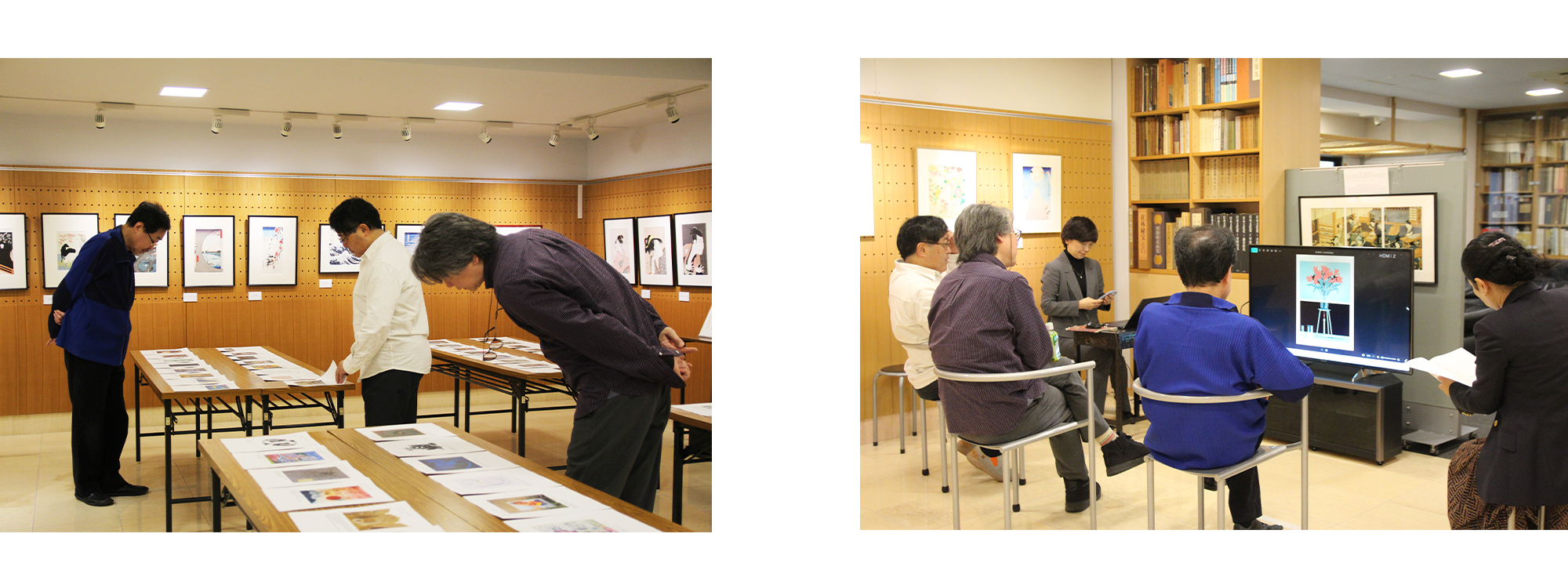
On February 16, 2026, a selection meeting was held with three judges and the Chairperson of the Foundation in attendance. Based on a total of 395 submissions from applicants in Japan and overseas, the judges conducted a comprehensive evaluation of each applicant’s artistic style, achievements in their creative practice, compatibility with traditional woodcut techniques, and potential as a contemporary ukiyo-e artist. As a result, four applicants were selected: one for the Grand Prize, one for the Excellence Award, and two for Honorable Mentions.
The two recipients of the Grand Prize and the Excellence Award will go on to collaborate with contemporary carvers and printers to produce new ukiyo-e works.
<Winners>
300,000 yen + the artist’s work will be made as a woodcut print by the contemporary artisans and complete print will be givenExcellence Award: Anuj Shrestha
150,000 yen + the artist’s work will be made as a woodcut print by the contemporary artisans and complete print will be givenHonorable Mentions: Karen Arai, Hiroto Katsukura
50,000 yen
<Grand Prize> Beniko Choji
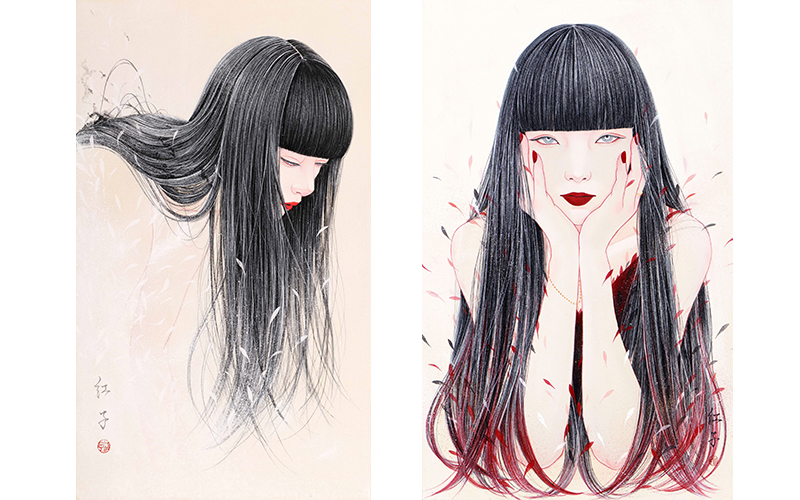
Hahen (Fragments of My Heart.) , Uchigawa (The Inner Self.)
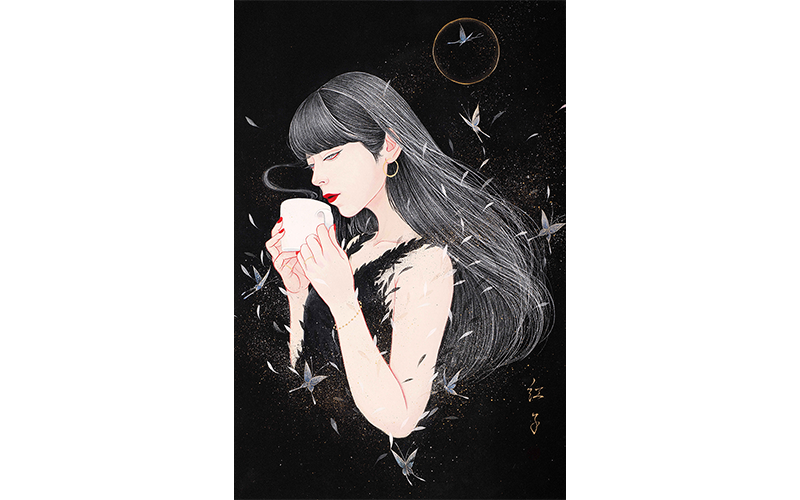
Tokubetsu na Yoru (A Night of My Own.)
【Judges’ Comments】
Her use of a limited palette of black, white, and red also resonates with ukiyo-e, which has long pursued effective visual expression within constraints such as restricted colors and a fixed number of woodblocks.
Traditional woodcut prints are created through the collaboration of three specialists — the artist, the carver, and the printer. Great anticipation now surrounds the commemorative work that will be produced through this collaboration with Beniko.
<Excellence Award> Anuj Shrestha

Study I , Study III
【Judges’ Comments】
Born in Kathmandu, Nepal, and raised in the United States from a young age, he explains that his work focuses on the visual symmetry created by placing two images in contrast, as well as the sense of “rhyme” that flows between them. This distinctive approach to composition was recognized as resonating with the spirit of ukiyo-e, leading to his selection for the Excellence Award.
<Honorable Mention> Karen Arai

Biidoro Otomefu (Glass Maiden Chronicle)
【Judges’ Comments】
She notes that she is drawn to the short Taisho period, when Western culture and Japanese traditions intersected to give rise to a new aesthetic sensibility, and this inspiration is clearly reflected in her work. We look forward to seeing her continue to refine her artistic style and further develop a visual language that will be instantly recognizable as her own.
<Honorable Mention> Hiroto Katsukura
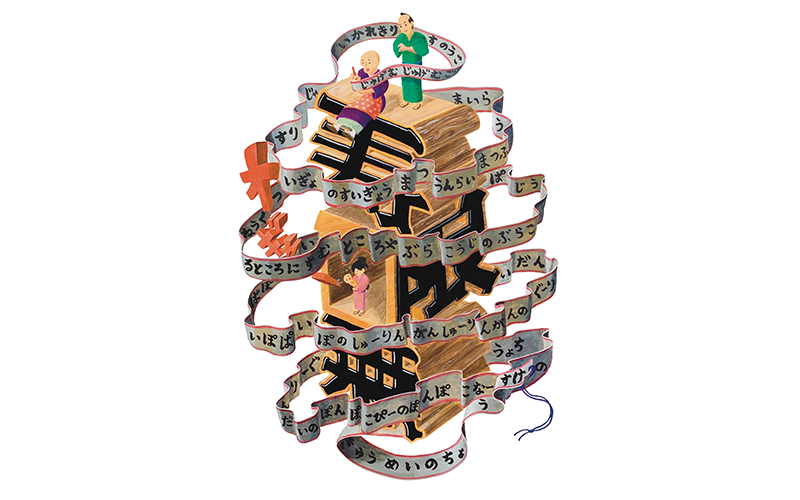
Jugemu (Jugemu)
【Judges’ Comments】
Among his submitted works, the piece inspired by the classic rakugo opening story Jugemu (Jugemu) particularly caught the judges’ attention. We look forward to seeing him further develop his text-centered approach and present future works with even greater precision and refinement.
【General Comment from Judges】
For the Adachi UKIYOE Award 2025, marking its 17th year, applications were accepted through an online system. A total of 395 applications were received, including 77 from Japan and 318 from overseas. Applicants came from 64 countries, including Japan, reflecting the Award’s growing global recognition.
The submitted works were evaluated by three judges, who assessed each artist’s individuality and technical ability while considering their potential as a ukiyo-e artist, as well as whether the works demonstrated qualities and possibilities that would be enhanced when realized as woodcut prints. The selection process began with several rounds of screening using printed images of all submissions. In the second stage, the judges conducted a detailed review of the selected works, examining each applicant’s background and complete submission before ultimately selecting four award recipients.
This year saw a significant increase in overseas applications, more than tripling compared to the previous year. However, it was also noted with some regret that many submissions did not fully reflect an understanding of the Award’s purpose — namely, to discover artists with the potential to become contemporary ukiyo-e artists by identifying works that could serve as original designs for woodcut prints. We hope that future applicants will develop a deeper understanding of the unique collaborative process of ukiyo-e production and the specific role of the artist within it. It is also important to recognize that Edo-period ukiyo-e embodied a wide range of elements characteristic of their time, an aspect that should be kept in mind when selecting subjects and themes.
From this perspective, the four award-winning works were all highly regarded for demonstrating the potential to become ukiyo-e artists, presenting clear artistic intentions, and possessing qualities that would be further enhanced when realized as woodcut prints. The two recipients of the Grand Prize and the Excellence Award will now undertake collaborative production with artisans who carry on traditional woodcut techniques. We look forward with great anticipation to the new ukiyo-e works that will emerge from these collaborations.
For future applicants, we hope they will approach their submissions with a deeper understanding of the Award’s objectives and that the experience of applying will serve as an opportunity for further artistic growth and development.